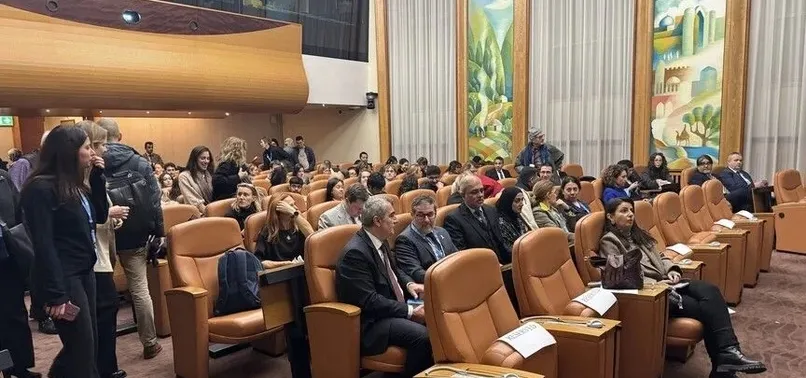
"NAZA," a documentary about Israel's killing of civilians in the Gaza Strip, was screened Thursday at the United Nations Office at Geneva.
Palestine's Permanent Observer Mission to the UN Office at Geneva organized the screening. The permanent representatives of Türkiye, South Africa, Lebanon, Iraq and Brazil attended, along with representatives of other diplomatic missions and organizations. The ambassadors were Ayse Sozen Usluer of Türkiye, Zaheer Laher of South Africa, Caroline Ziadeh of Lebanon, Saywan Barzani of Iraq and Ricardo de Souza Monteiro of Brazil.
Speaking before the screening, Dania Dasouqi, first secretary at Palestine's Permanent Observer Mission, conveyed greetings from Permanent Observer Ibrahim Khraishn, who was unable to attend because of urgent travel commitments.
Dasouqi said the film drew on testimony from 24 Israeli military and intelligence personnel who described how artificial intelligence was used to target civilians in Gaza.
She thanked the filmmakers, who she said had faced attacks and threats from Israeli authorities for bringing the testimony to light.
Dasouqi said the testimony showed how Palestinian lives had been reduced to expendable data and civilian populations used as testing grounds for military technology. She said such practices must never become the norm and called for accountability for those who developed, deployed and used the systems.
She also said the Review Conference of the Convention on Certain Conventional Weapons had failed to agree even to open negotiations on a legally binding instrument on autonomous weapons. She called that failure indefensible after more than a decade of discussions.
Dasouqi said genocide had been ongoing in Gaza for more than three years and that Palestinians remained trapped in a nightmarish situation.
She said Palestinian testimony should never have needed validation from Israelis. She hoped the film would reach people who remained unconvinced by Palestinian accounts and prompt diplomats to reconsider positions that had delayed efforts to protect civilians.
Dasouqi said documenting harm was insufficient unless it led to a change of course. She said the film called for urgent investigations, accountability and action, adding that the consequences were irreversible and the responsibility to act remained.


