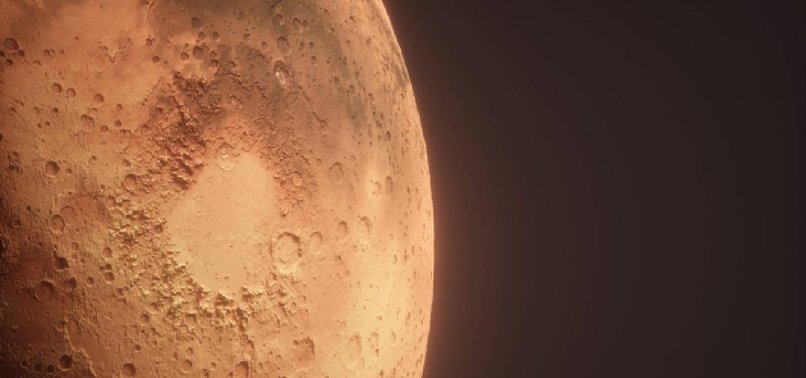
Scientists have made a surprising discovery that time progresses faster on Mars relative to Earth. According to new research, clocks on Mars, when measured from Earth, run faster by an average of 477 microseconds (one millionth of a second) every 24 hours.
Albert Einstein's Theory of General Relativity shows that the rate at which time flows in a region depends on the gravitational force in that area. In places with strong gravity, clocks run slower, and in places with weaker gravity, they run faster. This is why people living at the top of mountains age slightly faster than those at sea level, by a very small fraction.
There are two main reasons for the acceleration of time on Mars:
Weaker Gravity: Mars' surface gravity is five times less than Earth's at sea level. This is the biggest factor causing clocks on Mars to speed up.
Orbital Speed: As a planet's orbital speed increases, the flow of time accelerates. Although Mars' orbital speed is slower than Earth's, the accelerating effect of weak gravity largely offsets this slowdown.
Physicists Neil Ashby and Bijunath Patla from the National Institute of Standards and Technology (NIST) included Mars' elliptical orbit shaped by gravitational effects from Earth and the Moon in their calculations.
While analyses show that time on Mars runs on average 477 microseconds faster, they also reveal that this value can vary daily by as much as 226 microseconds throughout a Martian year. This daily fluctuation stems from Mars' elliptical orbit and the constantly changing gravitational influences of its neighbors.
Researchers note that these findings could help in creating a standard clock across the Solar System in the future and establishing fast communication channels for an interplanetary "internet." However, Patla added that these significant fluctuations could make precise time synchronization challenging.


