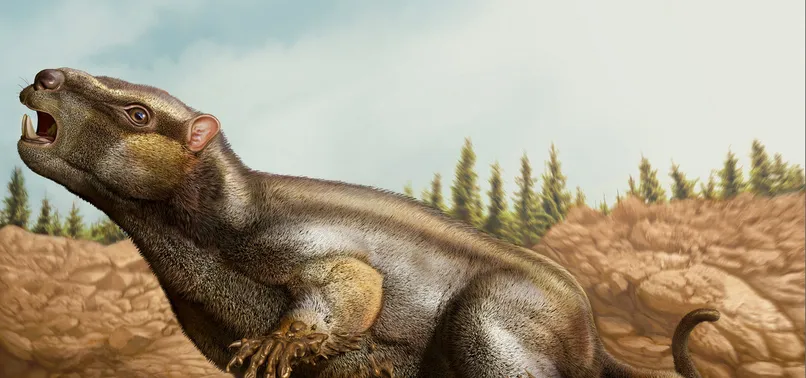
The fossilized lower jaw was found by Benjamin Weston, a paleontology student at the University of Portsmouth, during a field study at Durlston Bay in Dorset. Measuring just 16.5 mm, the jaw belonged to a small mammal that lived alongside dinosaurs.
The specimen is part of an ancient group of mammals known as multituberculates, recognizable by their ridged molars. These mammals survived for around 130 million years, evolving into species ranging from mouse-sized to beaver-sized.
The newly identified species has been named Novaculadon mirabilis. "Novacula" refers to the animal's razor-sharp back teeth, while "mirabilis" reflects the remarkably well-preserved condition of the fossil.
The jaw features a long, sharp incisor at the front, followed by a gap and four sharp-edged premolars. Artistic reconstructions suggest Novaculadon was small enough to fit in a human palm and may have had a spotted, striped, and furry appearance.
Based on its teeth, the animal is believed to have been an omnivore, feeding on small invertebrates like worms and insects.
Due to its delicate condition and the surrounding rock matrix, the fossil could not be examined using traditional methods. Portsmouth University used advanced CT scanning technology to digitally "clean" the fossil. Former student Jake Keane, now based in Abu Dhabi, processed the scans to isolate each tooth virtually.
The university's 3D printing lab then created enlarged replicas—10 times the original size—allowing detailed analysis without damaging the fossil.
The discovery sheds light on how early mammals survived under the dominance of dinosaurs and adapted to fill ecological niches. While multituberculates survived the mass extinction that ended the Cretaceous, they eventually went extinct during the Oligocene period around 33 million years ago.


