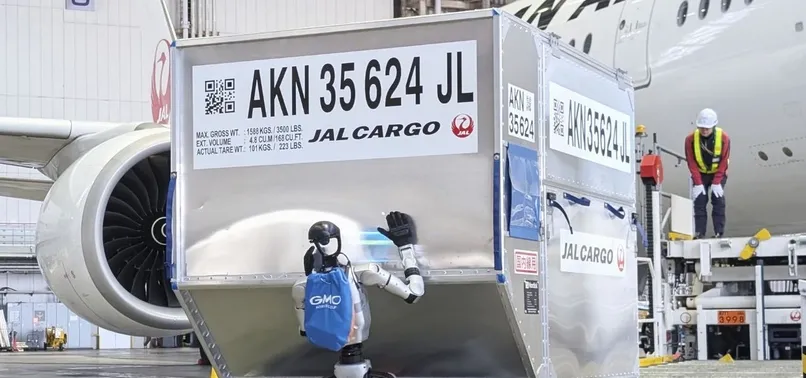
The Chinese-made robots, which will be used at Haneda Airport, serving over 60 million passengers annually, transported passenger luggage and cargo on the airplane tarmac.
This experiment, conducted by JAL and its partner GMO Internet Group, is planned to continue until 2028.
The primary goal of the initiative was announced to be to alleviate the physical burden on airport personnel, who are struggling due to the aging population and decreasing workforce.In a demonstration for the media, a 130 cm tall robot, produced by Hangzhou-based Unitree, was seen successfully pushing cargo onto a conveyor belt.
Yoshiteru Suzuki, Head of JAL Ground Services, stated that robots taking on physically demanding tasks would bring significant benefits to employees.
However, Suzuki emphasized that critical and decision-making tasks, such as safety management, would continue to be performed by humans.
Japan has experienced a tourism boom while simultaneously struggling with a declining population. According to data from the Japan National Tourism Organization, after a record 42.7 million in 2025, over 7 million tourists visited the country in just the first two months of 2026.
Estimates showed that Japan would need more than 6.5 million foreign workers by 2040 to achieve its growth targets.
Officials, stating that much of the work behind airport operations still heavily relies on human labor, aim to expand the use of robots.
These robots, capable of working continuously for 2 to 3 hours, are planned to be used in different tasks, such as aircraft cabin cleaning, in later stages.


