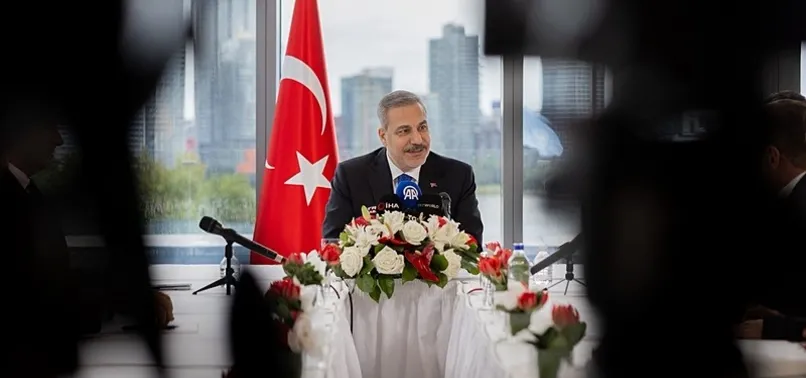
Türkiye championed dialogue over conflict, diplomacy over crisis, and cooperation over division during the UN General Assembly's high-level week in New York, Foreign Minister Hakan Fidan said Saturday.
Speaking at a news conference following the busy week, Fidan said he had taken part in more than 40 bilateral meetings and multilateral gatherings, with Palestine remaining a central issue on Türkiye's diplomatic plate.
"We advocated dialogue over conflict, diplomacy over crises, and cooperation over division," he said, stressing Ankara's commitment to resolving regional and global challenges through diplomacy.
Fidan said the Turkish delegation brought up Israel's genocidal policies in Gaza and its occupation and annexation activities at every meeting it attended.
He noted that in his 16th address to the UN General Assembly, President Recep Tayyip Erdoğan once again drew international attention to the plight of the Palestinian people.
The president also held 16 bilateral meetings, attended a high-level event on climate action and just transition, and took part in a meeting with US President Donald Trump and Gulf Cooperation Council leaders on regional issues.
He also met Turkish citizens living in the US, Turkish and American businesspeople, and representatives of US think tanks.
Fidan described Erdoğan's address to the General Assembly as a manifesto setting out Türkiye's global vision.
Fidan said he met with his counterparts from Indonesia, Qatar, Egypt, Pakistan, Saudi Arabia, Jordan, and the United Arab Emirates in an eight-country format to discuss Palestine.
He also took part in meetings addressing last year's New York Declaration and comprehensive peace plan.
In addition, he held four-way talks with the foreign ministers of Pakistan, Egypt, and Saudi Arabia, as well as trilateral discussions with his Syrian and Saudi counterparts.
Fidan said he also met the foreign ministers of Pakistan and Saudi Arabia under the Mecca Alliance framework for comprehensive consultations.
As chair of the Organization of Islamic Cooperation's Council of Foreign Ministers, he presided over its annual coordination meeting in New York.
Türkiye also co-hosted a meeting with the US titled "International Support for Peace, Unity and Prosperity in Libya," he added.
Fidan said regional and global developments were discussed at an informal meeting of the Organization of Turkic States' Council of Foreign Ministers.
He also attended the 30th MIKTA foreign ministers' meeting ahead of Türkiye assuming the group's chairmanship in 2027.
Fidan said that during the high-level week, Türkiye contributed to UN efforts on migration, development, humanitarian assistance, dealing with climate change, and food security.
Turkish officials also took part in meetings on the Rohingya issue, the Alliance of Civilizations, and Crimea, while Türkiye hosted a meeting of the Group of Friends of Mediation.
He stressed the need for the international community to develop common solutions to shared challenges, reiterating Ankara's position that regional problems should be addressed through regional ownership rather than seeking solutions elsewhere.
Fidan said Türkiye also reaffirmed its long-standing support for reforming the UN system.
During the high-level week, Türkiye also outlined its priorities and initiatives for the COP31 UN Climate Change Conference, which it will chair and host this November, he added.
Fidan said Israel is facing growing international isolation as diplomatic efforts increasingly translated international opposition to its actions into concrete measures and policies.
"Thanks to diplomatic efforts, Israel's oppression and massacres no longer go unanswered to the same extent as before. It now has to pay a very heavy price for every action it takes," he said.
He pointed to legal proceedings involving the International Court of Justice and the International Criminal Court as examples of the rising pressure on Israel.
On Erdogan's meeting with Trump and Gulf leaders, Fidan said the discussions focused on challenges facing the Gaza peace plan launched last year, including Israel flouting its provisions, as well as ongoing tensions in the Gulf.
Erdogan also presented Türkiye's proposals for regional peace, addressing the situation in Gaza, the threat posed by Israeli expansionism, and efforts to resolve the impasse over the Strait of Hormuz, he added.
Fidan said Türkiye, Saudi Arabia, and Pakistan are continuing efforts to establish its institutional structure, with the aim of appointing a secretary-general within two weeks.
Pakistan has proposed a candidate who is likely to be accepted by the other member states, he said, adding that further appointments will follow once the secretary-general takes office.
Fidan said the three countries also discussed military threats facing Saudi Arabia, including attacks by the Houthis from the south and other attacks from the north.
He said a military-technical assessment meeting had been held in the Saudi capital Riyadh on Friday with the participation of Turkish Chief of General Staff Gen. Selcuk Bayraktaroglu.
Fidan said he had spoken with Bayraktaroğlu to coordinate military assessments with the political approach and had also briefed Erdoğan.
On tensions between the US and Iran, Fidan said he had discussed Tehran's latest proposal with Iranian Foreign Minister Abbas Araghchi, including Iran's conditions for reopening the Strait of Hormuz.
He said he had also received initial impressions of the US response to the proposal but stressed that diplomatic efforts have yet to produce a breakthrough.
"The positive thing is that efforts are continuing. The negative aspect is that they have not yet yielded any results," he said.
Citing a telephone call between Erdoğan and Trump, Fidan said Türkiye wants diplomatic efforts to continue without a renewed outbreak of hostilities.
He added that Türkiye's Gulf partners, who have been directly affected by the crisis both economically and militarily, share Ankara's preference for a diplomatic solution.
On developments in Iraq, Fidan said Baghdad had adopted a policy aimed at disarming all armed groups in the country, including the PKK and affiliated groups operating in the Sinjar region.
He said the issue had been discussed during Erdoğan's meeting with Iraqi Prime Minister Ali al-Zaydi at the Turkish House in New York.
"We are very pleased to see that the Iraqi side has set a political objective of disarming all armed groups in the country. This is a vision we support," Fidan said.
He noted that Türkiye's military presence in Iraq, particularly at the Bashiqa base, had originally been established for counterterrorism purposes in cooperation with Iraqi authorities.
As Baghdad implements its roadmap to eliminate terrorism and disarm armed groups, Türkiye could gradually reduce and eventually end its military presence at Bashiqa, he said.