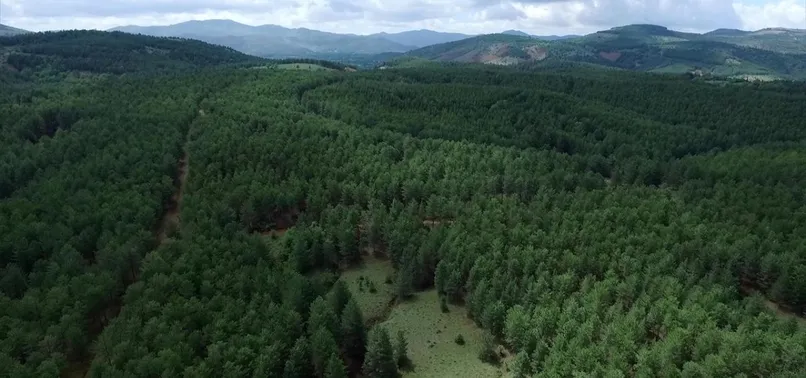
As global warming and industrialization continue to threaten forested areas worldwide, Türkiye, China, Russia, and India ranked among the countries that expanded their forest areas the most between 2015 and 2025.
According to data compiled from the UN Food and Agriculture Organization's (FAO) Global Forest Resources Assessment for this year, 4.14 billion hectares of land across the world are covered by forests, representing 32% of global land area.
Per capita forest area corresponds to 0.50 hectares, while tropical regions account for 45% of the world's forests.
Forested areas in Europe make up 25% of the global total, while South America stands out as the region with the highest forest density relative to land area.
Fifty-four percent of the world's forests are found in just five countries: Russia, Brazil, Canada, the United States, and China.
The FAO report provides data on annual net forest loss worldwide, noting that losses fell from 10.7 million hectares annually between 1990–2000 to 4.12 million hectares over the last decade.
Forest expansion in Asia has slowed in recent years, while forested areas in South America have significantly declined.
It is estimated that 489 million hectares of forest have been lost globally due to deforestation since 1990. Forest expansion rates dropped from 9.88 million hectares annually between 2000–2015 to an average of 6.78 million hectares in the last decade.
Naturally regenerating forests account for 3.83 billion hectares — 92% of the world's total forest area. This category shrank by 324 million hectares between 1990 and 2025. Net annual losses fell from 13.8 million hectares (1990–2000) to 6.97 million hectares (2015–2025).
The FAO report highlighted that although global warming and industrialization threaten forests worldwide, Türkiye ranks among the countries increasing forest areas the most each year.
China leads globally, expanding its forest area by 1.686 million hectares annually over the past decade, followed by Russia (942,000 hectares) and India (191,000 hectares).
During the same period, Türkiye increased its forest area by 118,000 hectares annually (0.53%), ranking first in Europe and fourth in the world.
Australia (105,000 hectares), France (95,900), Indonesia (94,100), South Africa (87,600), Canada (82,500), and Vietnam (72,800) follow Türkiye.
Brazil recorded the world's highest forest loss between 2015–2025, losing an average of 2.942 million hectares annually.
Angola (510,000 hectares), Tanzania (469,000), Myanmar (290,000), the Congo (283,000), and Mozambique (267,000 hectares) followed Brazil.
Cambodia (251,000 hectares), Peru (239,000), Bolivia (232,000), and Paraguay (207,000 hectares) also suffered major losses.
Except for Cambodia, all countries with the greatest forest loss are in South America and Africa.
The FAO report emphasized that forest fires were among the most damaging factors, affecting an average of 130 million hectares annually between 2007–2019.
Insects, diseases, and severe weather events affected around 41 million hectares of forest in 2020 alone.
Protected forest areas worldwide are estimated at 813 million hectares — roughly 20% of global forests.


