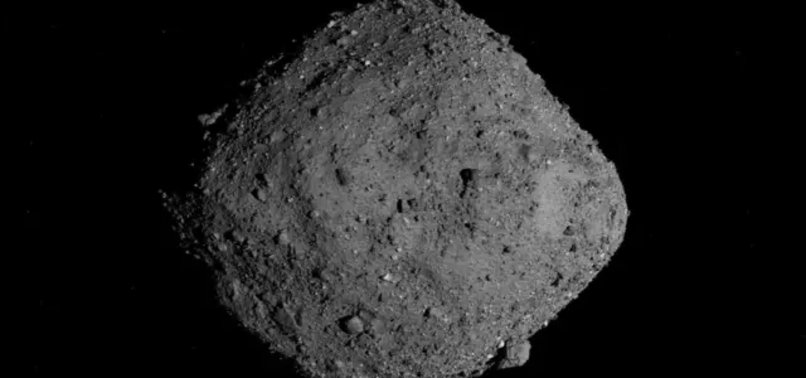
Three new scientific articles, co-authored by Jessica Barnes of the University of Arizona, have proven that Bennu's structure contains stellar remnants that existed before the formation of the Solar System. The samples were found to contain presolar grains, organic compounds formed in interstellar space, solid particles shaped in regions very close to the Sun, and dust with abnormal isotopic compositions from distant regions.
These materials show that the parent body from which Bennu originated was formed from particles of different origins that came together over 4 billion years ago during the first stages of the Solar System's formation.
The studies also proved that hydrothermal changes occurred in Bennu's composition. The asteroid's parent body was rich in ice from the outer Solar System. Over time, heat and collisions melted this ice, and the resulting water interacted with minerals, changing their composition. Traces of these water-rock interactions that occurred billions of years ago were found in 80% of the minerals analyzed in the samples.
A third study determined that Bennu's surface changes rapidly due to micrometeorite collisions and solar wind. Traces of melting were found in approximately 20% of Bennu's particles. This rate was 2% in the samples brought from Ryugu and 0.5% in those from Itokawa. The findings show that space weathering occurs much faster on carbon-based bodies.


