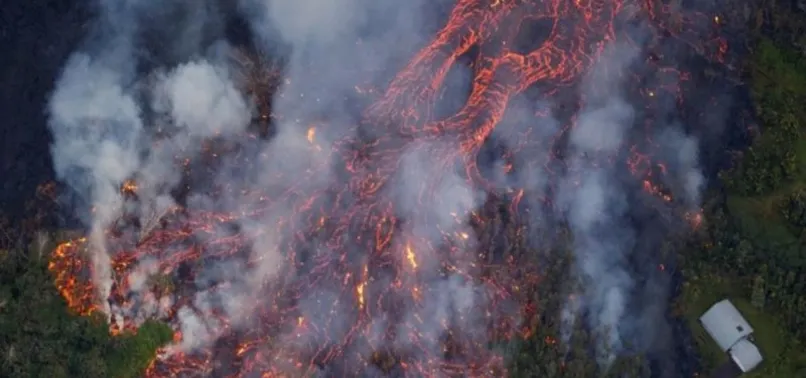
NASA has revealed that the carbon dioxide emitted by volcanoes before an eruption makes nearby trees greener. This new system could potentially serve as an early warning.
Volcanoes send hidden signals before they erupt. According to new research, the carbon dioxide gas released due to rising magma causes nearby trees' leaves to become greener and more vibrant. These changes can now be monitored from space via NASA satellites.
As magma rises toward the Earth's crust, carbon dioxide gas is released. Trees that absorb this gas grow faster, and their leaves become greener. This greening creates a clear signal that can be detected from space.
Thanks to NASA's Landsat 8 satellite and airborne instruments like the Airborne Validation Unified Experiment: Land to Ocean (AVUELO), scientists have started to consider these signals as part of an early warning system.
There are about 1,350 active volcanoes worldwide, and 10% of the global population lives in areas at risk from volcanoes. When volcanoes erupt, they can affect not only the surrounding areas but also people living miles away.
Therefore, early warning systems are vital. However, detecting the carbon dioxide levels emitted by volcanoes before they erupt is challenging because the amount is often too low for direct detection.
TRACKING TREES INSTEAD OF CARBON DIOXIDE
Rather than measuring carbon dioxide directly, NASA, along with scientists from the Smithsonian Institution, McGill University, and Chapman University, aims to track trees affected by this gas. This method allows for remote monitoring of dangerous areas while reducing costs.
Satellite analysis of trees around active volcanoes like Mount Etna has proven that color changes in trees are indeed related to magma movements.
During the AVUELO mission in March 2025, scientists collected leaf samples from active volcanoes in Costa Rica and simultaneously measured carbon dioxide levels. Researchers claim this study is groundbreaking both for ecology and volcanology.
NOT ALWAYS APPLICABLE
However, this method doesn't work everywhere. Not all volcanoes are surrounded by forests. Factors such as climate, weather, fires, or plant diseases can also affect the data.
Still, experts believe this method could greatly contribute to early warning systems. Sensors used around Mayon Volcano in the Philippines helped evacuate more than 56,000 people before a major eruption in 2018, preventing casualties.
A PROMISING METHOD FOR THE FUTURE
NASA officials state that while changes in trees alone may not be sufficient, they can play a key role in enhancing current systems and providing early signals.
"There is no magic signal for volcanoes," says Florian Schwandner from NASA's Ames Research Center in California. "But this could change the game."


