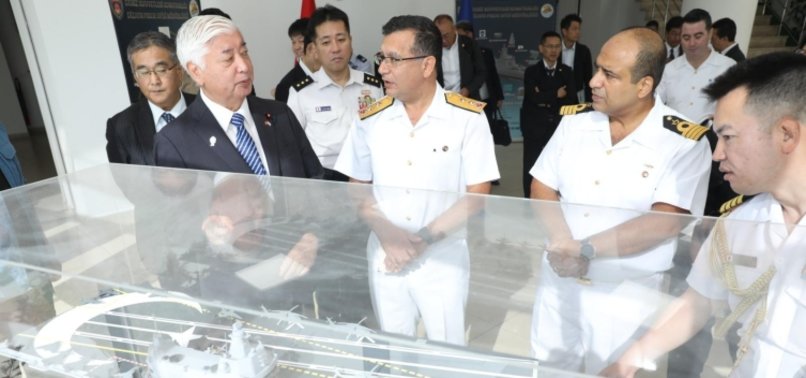
The Turkish defense industry concluded the year 2025 with remarkable achievements. Another highlight from last year included high-level visits from abroad regarding defense industry negotiations. In mid-last year, the Japanese Minister of Defense and his delegation visited Ankara, engaging in critical discussions. Toward the year's end, the Japanese Government announced that it would allocate a larger budget for defense expenses for the fiscal year 2026. One of the prominent topics in the budget discussions was the emphasis on initially procuring "critical products and systems from abroad."
We are aware of Japan's prior interest in the Bayraktar TB-2, though a purchase decision was not made. The previous government did not perceive the threat as imminent. However, the world has changed rapidly. Every country is arming itself according to its capabilities. At this point, discussions about new acquisitions for Japan include missiles, coastal defense systems, manned and unmanned aircraft, and submarines.
Yusuf Akbaba provides a valuable detail, noting that a Turkish company has already exported a Cloud-Beneath UAV to Japan. He comments that other Turkish drones could soon be on their way to Japan, adding, "The Japanese have allocated $640 million just for coastal defense. This figure could increase. By 2028, they want to have UAVs and surface and underwater vessels for surveillance and defense purposes in operation.
Certainly, the Bayraktar TB-3 comes to mind as one of the first platforms. It is a highly capable product, proven in the field. Turkish engineers have also managed take-off and landing operations from ships. The Japanese have two platforms intended to be converted from helicopter carriers to aircraft carriers, one of which they have completed. From those platforms, TB-3 can launch and perform extensive long-duration reconnaissance and intelligence gathering.
Public discussions often focus on Russia's 'Shadow Fleet.' However, the same concern exists for China. As of now, this massive fleet, used for fishing in international waters, no one can be certain what they could be used for if situations worsen. Thus, the Japanese want to perform round-the-clock surveillance. In this regard, Turkish drones come to the forefront.
Surveying an area involves more than just having a bird's-eye view. You need to be able to transmit the information you gather about the other side instantaneously to your other units. Turkish drones communicate instantly with each other and other platforms.
Moreover, Türkiye has developed a project called Coastal-Net by HAVELSAN, where all our coastal radars actually communicate with each other. I believe Japan could collaborate with Ankara on such systems.
Our next-generation unmanned platforms, KIZILELMA and ANKA-3, rest assured, are also on Japan's radar.
Public skepticism often questions, 'Why would Japan, a world leader in technology, buy Turkish drones?' Let's be clear... Türkiye is one of the top three countries in unmanned aerial vehicle technology. We currently have 7 major UAV projects in operation, and all these platforms have significant flight hours. They have libraries full of potential threat perceptions experienced in different locations, analyzed, and resolved. We also transfer this threat library to our new products.
After many years, Japan is establishing a military base outside its territory for the first time. They have again become aircraft carrier owners. Now they want highly advanced attack missiles. Clearly, they also intend to break out of their shell. At this point, Türkiye could be an important partner. I believe that the Turkish defense industry could take a leading role in Ankara-Tokyo relations."


