The discovery was made on October 9 at Wharton Beach in Western Australia, where the Brown family found a thick glass Schweppes bottle during a beach clean-up. Deb Brown, a member of the family, said, "We often clean beaches; we never ignore any litter. This little bottle seemed like it was just waiting for us there."
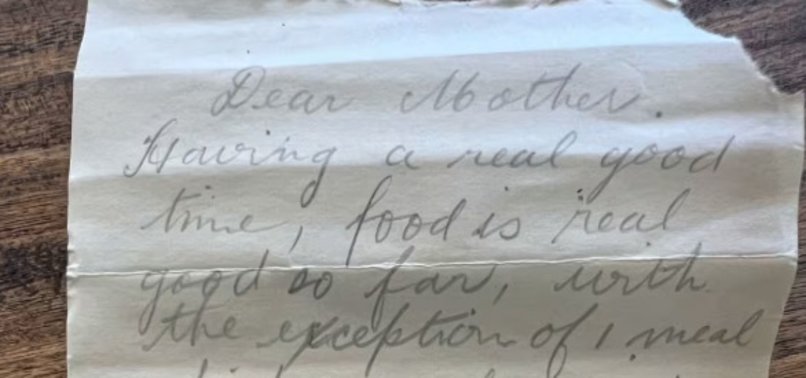
Inside the bottle, there were two letters written in pencil. The letters were penned by 27-year-old Private Malcolm Neville and 37-year-old Private William Harley on August 15, 1916.
The two soldiers wrote the letters just a few days after departing Australia, aboard the HMAT A70 Ballarat, which was en route to the front lines in France. This ship was carrying reinforcements to the 48th Australian Infantry Battalion fighting on the Western Front in Europe.
Neville died in combat a year later. Harley was wounded twice but survived the war. He died in 1934 from a disease his family attributed to the "German gas exposure in the trenches."
In the letter to his mother Robertina Neville, Malcolm wrote, "We are indeed having a good time. The meals are fine, except for one, which we buried at sea," and added, "The ship is rolling, but we are very happy."
Harley wrote, "May the finder be as happy as we are."
Neville requested that his letter be delivered to his mother if found, while Harley, whose mother had already passed away, noted that the finder could keep his letter.
Deb Brown believes that the bottle was likely buried in the coastal sand dunes rather than floating at sea for a long time. "The bottle is clean, with no signs of marine life on it. Had it been at sea that long, the papers would have disintegrated," she said.
Since the writings were still legible, the family reached out to the relatives of both soldiers.