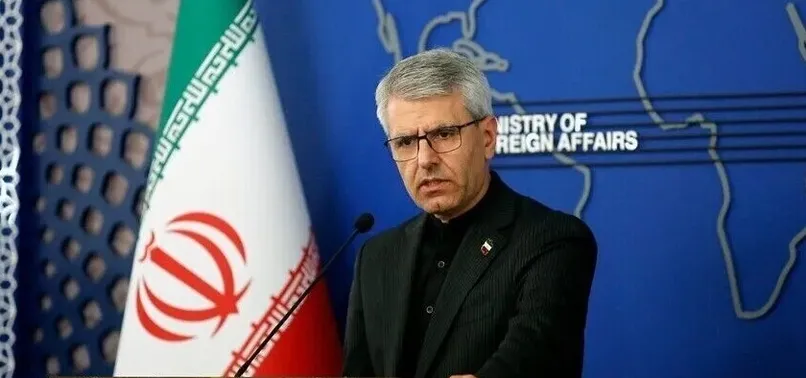
Iran said Monday that the "ball has long been in the US court" over the situation in the Strait of Hormuz, calling on Washington to halt its military attacks, economic measures, and naval blockade against Tehran.
Foreign Ministry spokesman Esmaeil Baqaei said at a news conference that Washington itself must end what he described as the insecurity it had imposed by stopping "all aggression, economic sanctions and the naval blockade."
"Our position was clear, and we included our views in the memorandum of understanding," Baqaei said.
He accused the US of violating its commitments 26 days after reaching the understanding.
"The ball has long been in the US court. They themselves started the aggression, and they themselves violated their commitments under the memorandum of understanding," he said.
Baqaei said talks between Iran and Oman on establishing a temporary safe route through the Strait of Hormuz had made "very good progress" and reached the final stage.
He expressed hope that the understanding would be registered with the International Maritime Organization in the coming days and urged third parties not to interfere in the process.
Baqaei also said regional diplomatic efforts to reduce tensions were continuing, noting that delegations from Oman and Pakistan had visited Iran in recent weeks.
He said a Qatari delegation was in Iran on Sunday as part of Doha's previous efforts to help de-escalate tensions and held what he described as "good meetings" with Iranian Foreign Minister Abbas Araghchi.
"Diplomacy is a dynamic and continuous process," Baqaei said, adding that Tehran would continue using diplomatic channels to safeguard its national interests.
The spokesman said the Strait of Hormuz had faced no security problems before US and Israeli military attacks on Iran, blaming the current insecurity on Washington and Israel.
He said security could not return to the strategic waterway as long as the naval blockade, economic measures, and attacks on Iranian commercial vessels continued.
Baqaei said the continuation of what Tehran calls an economic war and naval blockade would amount to a continuation of military aggression, arguing that Iran had the right, both legally and operationally, to take necessary measures in self-defense.
He also rejected the US account of Iran's military actions, saying Iranian operations against US military bases and warships were carried out under the inherent right of self-defense under Article 51 of the UN Charter.
Baqaei said Iran has faced continuous US military attacks since Feb. 28, accusing Washington of acting with Israeli involvement and continuing its campaign in various forms, including a naval blockade and economic measures.
He condemned a US attack last week in Sirik in southern Iran, saying it struck a wedding celebration in the Kuhestak area and killed several people.
Iranian officials previously said four people were killed and 68 others injured in the attack.
Baqaei also rejected recent remarks by US Vice President JD Vance referring to the hostilities as a "conflict," saying Washington could not conceal the nature or scale of its actions through rhetoric.
Turning to Iran's nuclear program, Baqaei said US and Israeli attacks on Iranian nuclear facilities were the main obstacle to access by the International Atomic Energy Agency (IAEA).
He accused the US and European countries of using reports by IAEA Director General Rafael Grossi, who heads the UN nuclear watchdog, as a tool to exert political pressure on Tehran.
"The US is responsible for this situation, and the fact that the IAEA does not have access is because of the crimes committed by the US and the Zionist regime," he said.
Baqaei said the latest move by the US and three European countries on Iran's nuclear file demonstrated "bad faith" and was aimed at escalating tensions.
He also argued that efforts to bring Iran's nuclear file before the UN Security Council again contradicted Western claims that previous UN resolutions had already been restored through the "snapback" mechanism.
Britain, France, and Germany triggered the snapback process in August 2025, accusing Iran of failing to meet its commitments under the 2015 nuclear deal. Previous UN sanctions were subsequently restored in September.
Iran, China, and Russia rejected the legality of the process, while the European countries maintained that they were entitled to invoke the mechanism under UN Security Council Resolution 2231.
On reports about a possible South Korean military contribution in the Strait of Hormuz, Baqaei said any participation in what Tehran considers US military aggression would amount to "complicity" and further complicate the situation.
He said Tehran had not taken a formal position on a possible South Korean deployment but had been in contact with Seoul through diplomatic channels, noting that Iran's warning applied to all countries and urging them not to become a tool for US military action against Tehran.
Baqaei said Iran-China relations remained "very good" and stable and were based on continuous contacts at various levels, adding that the absence of a lengthy bilateral meeting on the sidelines of a recent summit would not affect ties.
On possible negotiations, he said talks were neither inherently good nor bad, describing negotiations as a tool for advancing national interests and security.
He added that the Foreign Ministry would follow decisions taken by the relevant Iranian authorities, including the Supreme National Security Council.
Baqaei said Iran would use the upcoming UN General Assembly session to explain its position, provided the US, as the host country, fulfills its obligations and issues visas to the Iranian delegation on time.


