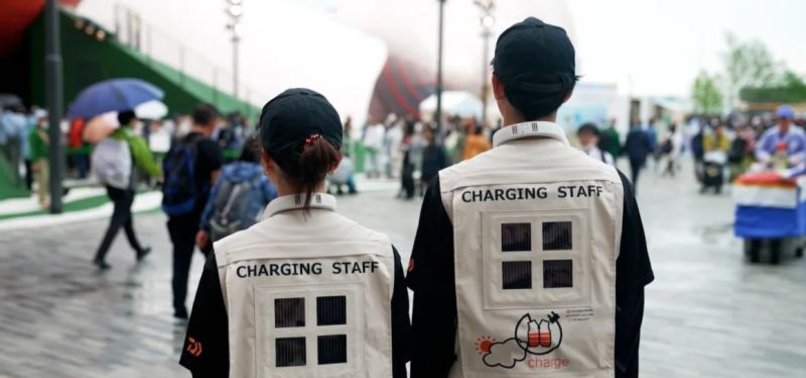
Ultra-thin and flexible solar panels showcased at Japan's Expo 2025 have been transformed into wearable technology. Weighing as little as paint, these panels are integrated into solar-powered cooling vests to help workers cope with hot weather.
As preparations continue for the 2025 World Expo in Osaka, Japan, workers are tackling the heat with an innovative solution: solar-powered cooling vests.
The ultra-thin, flexible solar panels on the vests weigh just 4 grams and power fans located around the neck area, providing cooling through wearable technology.
These vests were developed through a collaboration between Toyoda Gosei, a Toyota Group company, solar panel startup Enecoat Technologies, and textile manufacturer Seiren.
The panels used in the vests are made from crystals called perovskite, different from conventional silicon solar panels. This technology makes the panels much lighter, flexible, and capable of generating power even in low light conditions, including cloudy or shaded environments.
In laboratory tests, these panels operate at 21.2% efficiency. They are currently being tested in real conditions at the Expo 2025 site, where daily performance data is collected.
One major advantage of perovskite cells is their ability to produce energy in low light. Enecoat Technologies CTO Tamotsu Horiuchi highlighted that the panels can generate power from LED and fluorescent lighting as well. Additionally, they can be used on surfaces that cannot support heavy silicon panels, such as roofs.
At the Expo site, perovskite panels are featured not only in wearable tech but also in curved smart poles, bus terminal roofs, and the artistic exterior of the Panasonic pavilion.
Despite their benefits, perovskite panels face two major hurdles for commercial use:
Short lifespan: They are more sensitive to sunlight, moisture, and UV rays compared to silicon panels.
Lead content: Some types contain toxic lead, though the risk of leakage is low.
Scientists are working on protective glass layers, additives, and new manufacturing techniques to overcome these issues. Dr. Hashini Perera from the University of Surrey in the UK announced in recent research a method that could increase panel lifespan by up to ten times.
Japan aims to produce 20 gigawatts of solar power by 2040, equivalent to about 20 nuclear power plants.
The urban installability of perovskite panels could enable energy production where it's consumed, making cities more efficient.
According to Horiuchi, this technology could serve as an energy source for future wearable devices, from smartwatches to phones.


