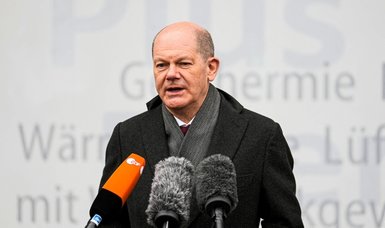
Germany is on Sunday dropping most of the regulations introduced to contain the pandemic, even as Covid-19 continues to spread.
Lawmakers greeted the move. A study shows that Germany had some of the strictest measures in place, alongside countries like Laos and Myanmar, Justice Minister Marco Buschmann said. He said other countries had eased the regulations sooner, and cautioned against thinking Germany knew better what to do, calling such an approach "German megalomania."
He also defended the adjusted legislation after criticism in some quarters, saying a strict regulation was better than a sloppy one.
Under the amended Infection Protection Act, most state requirements no longer apply in large parts of Germany. Only a few general rules can be imposed in most states, for example concerning mask-wearing in doctors' surgeries, nursing homes, hospitals, buses and trains, and during tests in schools.
However, irrespective of state rules, companies, shops and other facilities can continue to impose their own rules such as requiring masks to be worn.
Masks will also still be compulsory on trains and buses run by rail company Deutsche Bahn, a spokesperson said, adding that compliance would still be monitored.
The general easing was greeted as "an important and welcome step towards normality," by deputy Free Democrat (FDP) leader Wolfgang Kubicki. "We are implementing what has also been implemented in neighbouring European countries for some time," he told dpa.
However, debate continues over a general vaccination mandate, mask-wearing and the easing of quarantine rules.
Several lawmakers, including Health Minister Karl Lauterbach, recommended continued mask-wearing indoors, even if most requirements have been lifted.
Lauterbach said he himself would keep wearing his mask when shopping, for example, and advised others to do so, in comments to broadcaster Deutschlandfunk. "The risk of becoming infected has rarely been higher than it is now," he said.
Lauterbach said he expected case numbers to fall further, especially after Easter. Still, he said, there are 200 to 300 Covid-19-related deaths every day, a number he called unacceptable. "That's one plane crash every day."
Germany is also likely to impose a general Covid-19 vaccination mandate, Lauterbach said, just says ahead of a debate in the Bundestag.
On Thursday, the Bundestag is due to vote on several motions, among them compulsory vaccination from the age of 18 up, and one from the age of 50.
However, an opposition lawmaker spoke out against such a regulation and slammed Lauterbach for what he saw as excessive caution.
The head of Germany's conservative opposition said a failure by parliament to pass a general Covid-19 vaccine mandate would not do much harm to the country.
"If there is no compulsory vaccination in Germany for the time being, we would be in good company in the world," Friedrich Merz, the chairman of the Christian Democrats (CDU), tweeted on Saturday.
"There were better reasons for having compulsory vaccination at the beginning of 2022."
Merz acknowledged Germany's number of Covid-19 cases remains high - health authorities reported 196,456 new cases within the past 24 hours on Saturday - but said hospitals were not overburdened.
The nation's seven-day incidence rate of cases per 100,000 people per week was recently 1,586.4, lower than the previous week.
Merz accused Lauterbach, of the ruling centre-left Social Democrats (SPD), of viewing Germany's situation too bleakly.
"Minister Lauterbach likes playing the role of the concerned doctor who sees the whole of Germany as a hospital bed," Merz tweeted.
Lauterbach shot back on Twitter, saying he does not view Germany as one big sickbed: "But at the moment about 230 people a day are dying from/with the coronavirus. Every day. I want to prevent that in the autumn. Too many have become accustomed to the death of so many people."
The CDU rejects a general vaccination obligation and instead proposes that a vaccination register be established first. Under this proposal a "staged vaccination mechanism" would be introduced, which can be activated by the Bundestag and Bundesrat - the two chambers of the German parliament - depending on the severity of the pandemic situation.
Lauterbach tweeted that the proposal was not a solution.
Merz said that the government did not have enough lawmakers on board to pass a mandate for all adults. Germany's current mandate only applies to health and care staff.
Vaccination against the coronavirus is making very slow progress in Germany. On Friday, 36,000 doses were administered. Some 76% of the population has received two doses.
According to official data from Saturday, 58.8% have also received a booster vaccination.