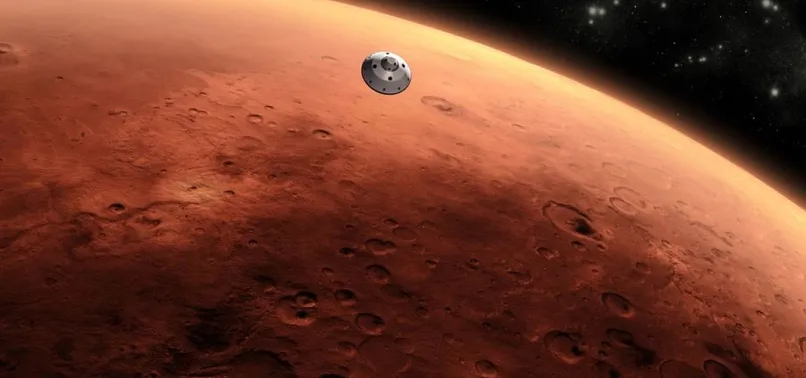
NASA's Curiosity rover has unlocked an important secret about the planet's past through a historic experiment conducted on the Martian surface.
The rover analyzed a rock sample by dissolving it in a special chemical solution, detecting carbon-containing organic molecules within it. According to the study published in Nature Communications, at least seven of the detected molecules are of a type never before identified on Mars.
Dr. Amy Williams and her team from the University of Florida emphasize that these molecules remained intact for 3.5 billion years despite Mars' harsh radiation environment.
This discovery confirms that Mars was not only habitable in the past but also possessed a geological structure capable of preserving organic matter for long periods. The findings support the idea that the planet once had conditions favorable enough for life to flourish, rather than being the cold and desolate desert it is today.
Since its landing in Gale Crater in 2012, Curiosity has been targeting clay layers in a region called "Mount Sharp." These areas were considered the most strategic points for the search for organic matter, as they bear traces of ancient lake beds and water movement. Samples taken from the region named "Mary Anning" were processed in a special analysis instrument inside the rover. Here, the "wet chemistry" method successfully revealed the identities of large and complex molecules.
One of the most striking aspects of the research was the discovery of structures known as "nitrogen heterocycles." These structures are considered precursors to molecules that carry genetic information, such as RNA and DNA on Earth. Additionally, the detection of a compound called benzothiophene on Mars, also found in the famous Murchison meteorite that fell in Australia, reinforces the idea that Earth and Mars were exposed to similar cosmic materials in the past and share similar building blocks.
Scientists cannot yet definitively prove whether these molecules are direct traces of ancient life or if they were formed through geological processes. However, this discovery is considered one of the turning points in the search for life on Mars. Experts agree that these samples must be brought back to Earth for the ultimate answer. This path opened by Curiosity provides a strong foundation for future missions to pursue the search for organic matter more deeply.


