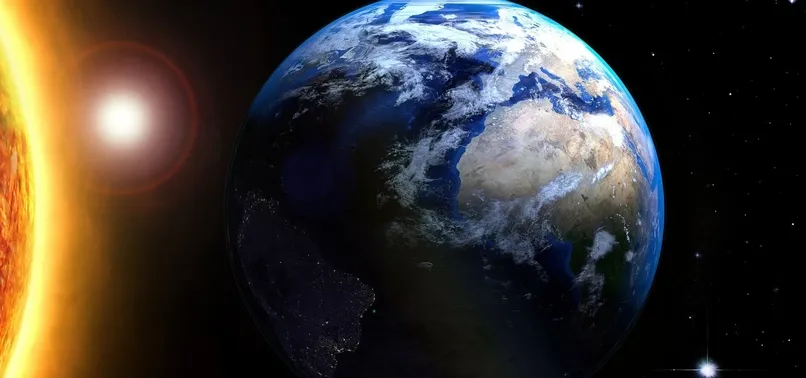
The life of planets begins with dust grains around young stars coalescing through massive collisions. However, defining a planet's end is much more complex than defining its formation.
In the scientific world, the death of a planet is accepted as either its complete physical disintegration or a permanent change in its habitable conditions. Looking at Earth's example, our planet's fate seems directly tied to the Sun's evolution. After approximately 5 billion years, as the Sun exhausts its fuel and transforms into a red giant, Earth will first become uninhabitable with its oceans evaporating, and then face the danger of being swallowed by the expanding Sun or flung into the vacuum of space.
When viewed in the context of the universe as a whole, Earth's lifespan is actually quite short. Red dwarf stars, which make up a large portion of the stars in space, can persist for trillions of years because they consume fuel much slower than the Sun.
Rocky planets around these stars can maintain their internal heat and geological activity for tens of billions of years. This demonstrates the existence of worlds that will "survive" much longer than Earth in the universe.
The ultimate fate of planets, however, is sometimes a major collision, and sometimes being flung out of orbit into the eternal darkness of the galaxy's depths. The true reality that puts an end to a planet's existence remains hidden in theories about how the universe itself will end.


