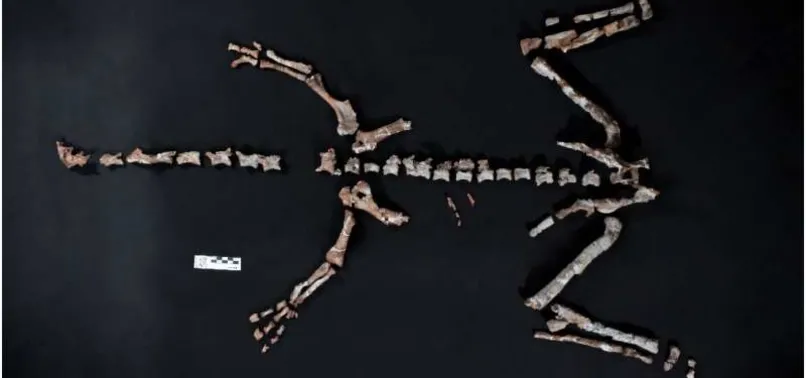
A groundbreaking discovery was made in the Andes Mountains of Argentina, where scientists uncovered fossilized remains of one of the world's oldest known dinosaurs, as reported by the CONICET research agency on Wednesday.
The find, spearheaded by a paleontological team from the institute, revealed an almost complete skeleton of the diminutive long-necked Huayracursor jaguensis, nestled at an elevation of 3,000 meters (9,842 feet) in the northwest of Argentina. The discovery included parts of the dinosaur's skull, a fully intact vertebral column stretching to its tail, and nearly complete forelimbs and hindlimbs.
Published in Nature magazine, this significant discovery is poised to enhance our understanding of dinosaur evolution. Agustin Martinelli, a member of the research team, noted that the Huayracursor walked the earth approximately between 230 and 225 million years ago during the late Triassic period an era marking the emergence of early dinosaurs and mammal ancestors.
Despite being part of a lineage that includes some of the large long-necked herbivorous dinosaurs, the adult Huayracursor jaguensis was relatively small, measuring around two meters in length and weighing about 18 kilograms (40 pounds). The findings promise to shed new light on the evolutionary pathways of these ancient creatures.


