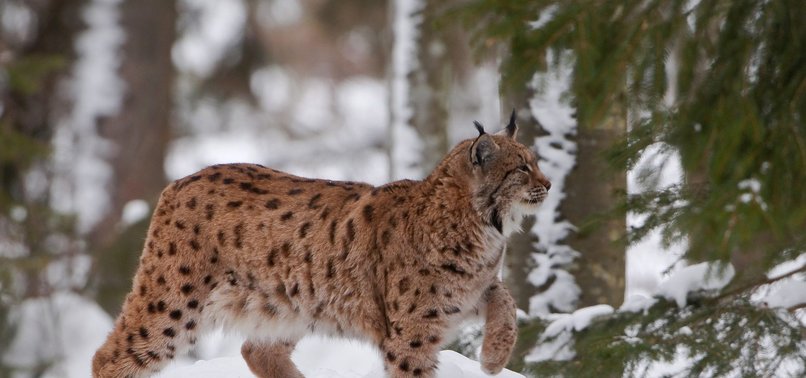
The Eurasian lynx population in the Slovenian Alps, which serves as a refuge for species adapted to high mountain ecosystems and forms an ecological corridor in Europe, faces a serious risk of decline.
In the ongoing Anadolu series "Europe's Peak: The Alps," focusing on global warming and its impacts on the Alpine region, the latest report examines wildlife in the Slovenian Alps.
Slovenia, which encompasses part of the Alps, hosts glacial valleys and high-altitude forests that are home to rare or endangered plant and animal communities.
The "Lynx LIFE Project," recognized with Europe's Nature Conservation Award in 2025, is an international conservation initiative aimed at strengthening lynx populations across the Alps.
Speaking to Anadolu, Miha Marence from the Slovenian Forest Service highlighted the serious threat of population decline facing the medium-sized wildcat.
He noted that, under the project, lynx have been translocated from the Carpathian region to prevent genetic isolation.
The award given to the project is based on its success in increasing genetic diversity and the effective reproduction of translocated lynx, Marence said, adding that the effort has also fostered strong collaboration between institutions and local communities.
He further mentioned that the Slovenian Forest Service participates in approximately 20 international and national projects annually, emphasizing practical implementation and efforts to improve species' living conditions.
Across Europe, excluding Russia, Eurasian lynx populations are estimated at around 9,000-10,000, according to the International Union for Conservation of Nature (IUCN), the global watchdog that assesses species extinction risks through its Red List, with separate subpopulations, including approximately 140-170 in the Alps and about 140 in the Dinaric region.
In Slovenia, the adult feral wildcat population has grown to around 50 as a result of conservation efforts, according to the LIFE Lynx project and Slovenian Forest Service 2024-2025 reports.
The "Lynx LIFE Project" is an EU-funded international initiative that translocated lynx from the Carpathians to prevent inbreeding and strengthen the population.
The Eurasian lynx is native to Europe and Asia, inhabiting a wide range of climates from boreal forests and taiga to mountainous regions and even semi-arid areas in Central Asia.


