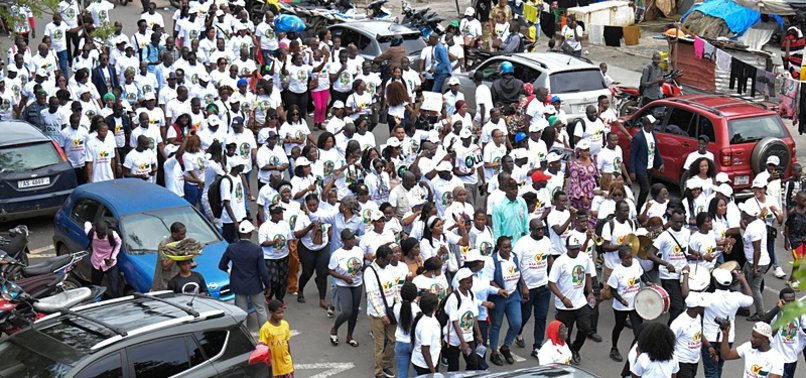
Guinea, which on Sunday holds a referendum on a new constitution, is one of the world's most impoverished countries, despite immense natural resources.
The former French colony became the second country in sub-Saharan Africa after Ghana to gain independence in 1958, before the decolonisation wave began in the 1960s.
It is the only Francophone state on the continent to have rejected in 1958 the Franco-African community proposed by then French president Charles de Gaulle.
Instead, the country plumped for independence and installed a socialist regime which Ahmed Sekou Toure would go on to rule with an iron fist for a quarter of a century.
The election on November 7, 2010, of longtime opposition mainstay Alpha Conde as Guinea's first freely elected president, opened a period of democratic transition after decades of autocratic regimes or dictatorships.
It ended with the military coup on September 5, 2021.
Since its arrival in power, the military junta led by General Mamadi Doumbouya has cracked down on civil liberties. It has banned protests since 2022 and has arrested, put on trial or driven to exile many opponents.
Sunday's referendum on a new constitution is theoretically a bid to return to constitutional order.
The military had initially promised to hand over power to civilians but there are indications that the head of the junta will stand for president.
Agriculture is the main source of employment in the country of 14.53 million inhabitants in 2024 according to the World Bank.
Spanning 245,900 square kilometres it has major mineral resources, notably bauxite, the chief mineral used in the production of aluminium, and also iron, gold and diamonds.
But the wealth from mining them is unevenly shared and benefits little of the population.
The country has one of the biggest deposits of iron ore in the world in the Simandou mountain range in the southeast.
Three decades after the discovery of the deposit, drilling is expected to start in the coming months and has necessitated the construction of a 670-kilometre-long railway, to link the inland region to the coast.
Guinea has benefited from strong GDP growth over the past few years, according to a recent report from the World Bank (5.1 percent on average between 2019 and 2023 and 5.7 percent in 2024). Poverty remains nevertheless high with 52 percent of the population living on less than $3.65 per day.
Guinea, after Somalia, has among the world's highest incidences of female genital mutilation (FGM). According to the United Nations children's agency UNICEF, around 95 percent of Guinean girls and women ages 15-49 were circumcised in 2024.
The country was also hit by the worst outbreak to date of Ebola, which started in there in December 2013 and lasted three years. The outbreak left 11,000 west Africans dead -- 2,500 of them in Guinea.
Guinea is, with Mali, the cradle of mandingo music played with traditional instruments including the harp-like kora and the balafon, a kind of xylophone.
One of its most famous exponents, Mory Kante, who died in May 2020, scored a global hit in 1987 with "Yeke Yeke".


