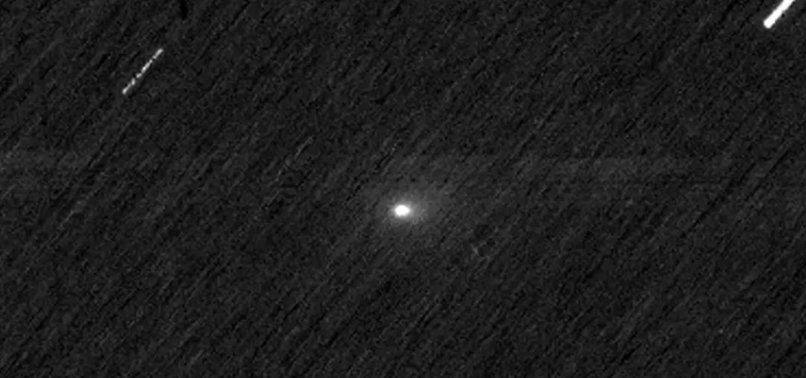
ESA's ExoMars Trace Gas Orbiter, which operates around Mars, imaged 3I/ATLAS from a distance of approximately 30 million kilometers (18.6 million miles) during observations that began on October 1st. The images published by the agency on Tuesday show a faint white dot moving through the darkness of space.
The bright spot in the images reveals the solid core of ice, rock, and dust, as well as the surrounding cloud of gas and dust known as the "coma." ESA scientist Nick Thomas said, "This was an extremely challenging observation for our spacecraft. Our target is normally the Martian surface, and this object was 10 to 100 thousand times dimmer."
3I/ATLAS is the third confirmed interstellar visitor to enter the Solar System, following 'Oumuamua in 2017 and 2I/Borisov in 2019.
Spotted in July, 3I/ATLAS has drawn significant interest from both professional astronomers and amateur observers. NASA reported that the object poses no threat to Earth and will remain about 270 million kilometers (170 million miles) away during its passage.
Scientists predict that 3I/ATLAS will reach its closest point to the Sun around October 30th. Currently too close to the Sun to be observed from Earth, the comet is expected to become visible again in early December.
The object, which was tracked by NASA's Hubble Space Telescope over the summer, will also be examined by observatories such as the James Webb Space Telescope, the Parker Solar Probe, and the Transiting Exoplanet Survey Satellite (TESS) in the coming period.
ESA emphasized that interstellar objects "hold clues as to how worlds are formed beyond the Solar System." The passage of 3I/ATLAS has opened a unique window into the origins of the universe for both spacecraft orbiting Mars and the scientific community.


